FORE:The third topic discussed at these conferences was the nature of the relations then subsisting between France and Spain, and the projects of the former power in reference to the latter. These were explained by the Minister without any reserve, and with no symptoms of apprehension that they would be disagreeable to Britain, or of anxiety as to the result, whether they were so or not. He frankly avowed that, under cover of the sanitary cordon, 100,000 French troops were assembled; that it was proposed to throw them in two columns into Spain; that one column, of 40,000 men, was to pass into Catalonia, while the other, of 60,000, was to march by the great road through Irun upon Madrid. He stated that the sole object of this invasion was to insure the personal safety of the king, to afford him the opportunity to collect a native force strong enough to enable him to protect himself against the schemes of the Revolutionists¡ªthat is, to put down the Constitution. Of course, France said she entertained no views of conquest or aggrandisement, or even of prolonged occupation. She would withdraw her troops whenever the King of Spain said he could do without them, and yield up every inch of territory. In reference to this matter the Duke of Wellington wrote home for instructions, and in reply Canning said:¡ª"If there be a determined project to interfere by force or by menace in the present struggle in Spain, so convinced are his Majesty's Government of the uselessness and danger of any such interference¡ªso objectionable does it appear to them in principle, as well as utterly impracticable in execution¡ªthat when the necessity arises¡ªor, I would rather say, when the opportunity offers¡ªI am to instruct your grace at once frankly and peremptorily to declare that to any such interference, come what may, his Majesty will not be a party." To say that England peremptorily declined "to be a party" to the invasion of an independent state, in order to force upon the people a government contrary to their will, was not saying very much, nor putting the objection very strongly. We are assured, however, that the Duke steadily set his face against the project, pointing out that the step would be not only unjust, but impolitic; that it would precipitate the catastrophe which the French Government feared; that the Revolutionists would probably remove Ferdinand from Madrid as soon as they heard of the passing of the frontier by the French troops, and that, even if these troops should reach the capital, the Spaniards would not therefore submit, nor would the king be set at liberty. He argued that a war between France and Spain for such a purpose would be pronounced a war to put down free institutions, and that if France sought the support of her allies, the only one amongst them that had free institutions would feel it her duty to meet such a request with a refusal. Europe would be ranged into two hostile camps, that of absolutism on the one side and of revolution on the other; amid which not thrones only, but settled governments in every form, might be overthrown. In reply to these arguments, both the king and his Minister stated that whatever France might do in the matter she would do single-handed, and that she would not only not apply for assistance from without, but that, if such assistance were offered, she would refuse it. The Duke could not, however, prevail upon the French Government to refrain from bringing the question between France[234] and Spain before the Congress. The king and his Minister both contended that vast moral good would accrue from a joint remonstrance on the part of the Allies against the treatment to which the King of Spain was subjected, and a joint threat that if any violence were offered to his person or family all would unite to avenge the outrage.By the Acts 6 and 7 William IV., c. 71, a Board of Commissioners, called the "Tithe Commissioners of England and Wales," was appointed, the object of which was to convert the tithes into a rent-charge, payable in money, but varying in amount according to the average price of corn for seven preceding years. The amount of the tithes was to be calculated on an average of the seven years preceding Christmas, 1835; and the quantity of grain thus ascertained was to remain for ever as the annual charge upon the parish. The annual money value was ascertained from the returns of the Comptroller of Corn, who published annually, in January, the average price of an Imperial bushel of wheat, barley, and oats, computed from the weekly averages of the corn returns during the seven preceding years. The Commissioners reported in 1851 that voluntary commutations had been commenced in 9,634 tithe districts; 7,070 agreements had been received, of which 6,778 had been confirmed; and 5,529 drafts of compulsory awards had been received, of which 5,260 had been confirmed. Thus in 12,038 tithe districts the rent charges had been finally established by confirmed agreements or confirmed awards.
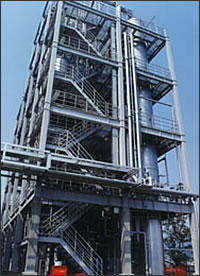
Hexane distillation systems, tall oil distillation systems, benzene distillation systems, lubricating oil refinement systems, xylene-free distillation systems, low-boiling gas distillation systems, ethylbenzene recovery systems, fusel oil distillation systems, naphthalene distillation systems, propylene recovery systems, and turpentine oil distillation systems.
FORE:De Crillon, seeing that his bombardment from shore produced little effect, determined to make the attack also from the sea. Amongst the multiplicity of inventions which the offered rewards had produced, the Chevalier D'Arcon, a French engineer, had produced a scheme which excited the most confident expectations. The plan was to construct ten monster floating batteries of such capacity that they should carry the heaviest artillery, and so made and defended that they could be neither sunk nor burnt. Loud was the clangour of hammer and saw, and, as the secret could not be long preserved, equally busy was the garrison within, preparing furnaces, and laying ready huge piles of balls, to be discharged red-hot at these machines as soon as they arrived. To constitute the intended batteries, ten large ships of from six hundred to one thousand four hundred tons burden were cut down, and made bombproof on the top. They were to be prevented from sinking by the enormous thickness of the timber in their bottoms, and their sides, which were to be six or seven feet thick, bolted, and covered with raw hides. They were to be rendered more buoyant by thicknesses of cork, and the interstices were to be filled with wet sand to prevent combustion. There were to be plentiful supplies, by means of pumps, pipes, and cisterns, of water, everywhere, to put out fire, for they seem to have been aware of the burning balls that were being prepared for them.
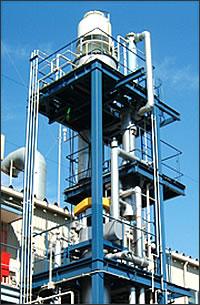
Ether distillation systems, camphor distillation systems, epichlorohydrin distillation systems, aniline distillation systems, dioxane refinement systems, acetonitrile distillation systems, furfural refinement systems, formalin distillation systems, cyclohexane distillation systems, monoethanolamine rectification systems, polyglycol ether distillation systems, dimethylformamide recovery systems, acrylic glycol ether distillation systems, acrylonitrile refinement systems, acetone recovery systems, pyridine distillation systems, methyl ethyl ketone recovery systems, picoline distillation systems, methyl isobutyl ketone recovery systems, and acetaldehyde recovery systems.